

Grocery Delivery App for Renters: How to Choose the Right Service

A grocery delivery app for renters makes fresh produce and everyday essentials just a doorstep away.
How do you choose the right grocery delivery app as a renter? Don't start with store selection; start with your building. The right grocery delivery app for renters is the one that handles gate codes, package rooms, and elevator timing as well as handles your shopping list. Look for apps that let you save detailed access instructions, offer real substitution control, and, ideally, connect directly to your property's access and concierge systems. One app that connects grocery delivery to everything else a renter needs, from local services to home help, is Amenify.
Why Grocery Delivery Apps for Renters Keep Failing at the Front Door
Picture this: you order groceries after a long day, and forty minutes later you get a "delivered" notification. Except your driver is still circling the block outside, trying to figure out which buzzer is yours. Eventually they give up, drop the bags in the lobby, and drive off. By the time you get downstairs, your ice cream has had its own personal summer.
If you rent, this probably sounds familiar. Grocery delivery apps were designed with a single-family home in mind: a driveway, a front porch, and a doorbell. Apartment living breaks almost every assumption baked into that model. There's a gate code that expires. A callbox that doesn't ring your unit. A package room that locks at 8 p.m. An elevator that takes ten minutes during the dinner rush. A roommate who ordered the same groceries you did, and now nobody knows whose oat milk is whose.
This isn't a minor inconvenience for a handful of people. It's the daily reality for a huge chunk of the country. Roughly 45 to 47 million U.S. households rent their home, about a third of all occupied housing units, according to Census Bureau housing-tenure estimates. And renters are far more likely to be without a car: somewhere around 15% to 18% of renter households report having no vehicle available, compared to just 4% to 5% of homeowner households. For a lot of renters, grocery delivery isn't a treat-yourself convenience. It's closer to infrastructure.
So the real question isn't "Which app has the best coupon this week?" It's which app actually understands what happens after the driver pulls up to your building?
What to Look for When Choosing a Grocery Delivery App as a Renter
If you're trying to choose the right service, skip the coupon comparisons and check for these instead; they're the things that actually determine whether delivery becomes a reliable habit or a recurring headache:
Building access is treated as real data, not an afterthought. Gate codes, callbox names, floor numbers, and elevator notes get saved and actually read, not buried in a comment box.
Delivery windows account for building behaviour. Avoiding elevator rush hour or move-in weekends prevents half the chaos before it starts.
Substitutions are handled item by item, so you're not stuck with kale when you ordered spinach.
Unattended delivery has a real plan: package rooms, smart lockers, or a concierge desk instead of "left at the front door" and a prayer.
The building itself is part of the system. When a delivery platform can plug into property access rules or a concierge workflow, half the failure points disappear before a driver even shows up.
That last point is where the market is genuinely shifting. Traditional marketplaces are great at inventory. They're not built to know that Building B's east entrance requires a call to the front desk after 6 p.m. That's a property-level problem, and it needs a property-level solution, which is exactly the gap resident-commerce platforms are stepping into.
The Grocery Delivery Apps Renters Usually Try First
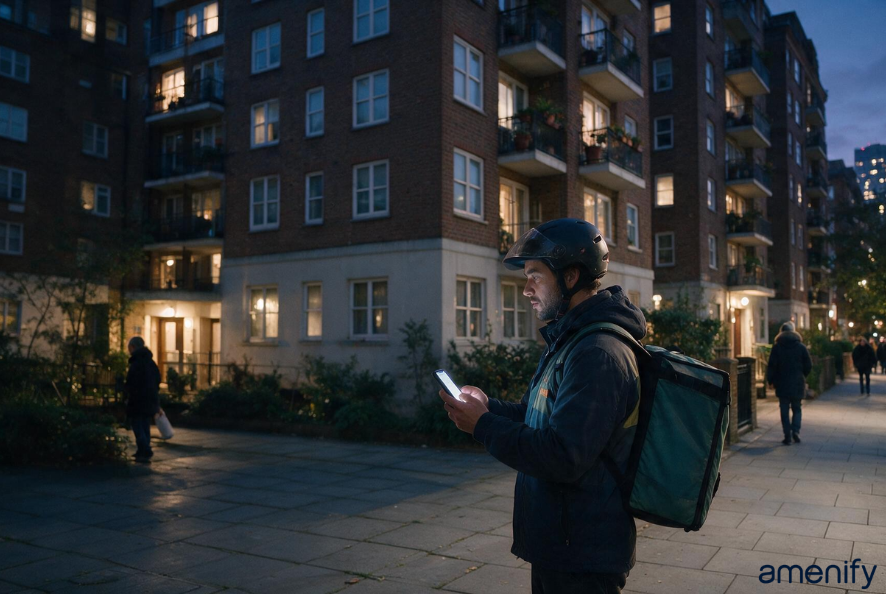
Gate codes, callboxes, and locked lobbies: the real reason grocery deliveries go wrong.
Most renters land on one of two kinds of apps: broad marketplaces (Instacart, Shipt) and retailer-owned apps (Walmart+, Amazon Fresh, Kroger, Target). They're fine as far as generic delivery goes, with a wide store selection, familiar checkouts, and loyalty pricing if you stick to one chain. If you're comparing prices across a few stores or want same-day delivery from whichever retailer has the shortest wait, these apps do that job well enough. A few apartment-specific services like Fetch have also popped up, bundling grocery with package handling for renters, a sign that even outside the resident-commerce space, the market has noticed apartment logistics need a different approach than a suburban front porch.
The catch is that none of them were built around the building. They're designed to move inventory from a store shelf to a checkout screen efficiently, and they do that part well. What they're not designed for is the second half of the job: gate codes, package rooms, elevator timing, callboxes that don't ring the right unit, or a driver trying to guess which of forty identical doors is yours. That gap doesn't show up in the app's marketing or its star rating. It shows up the first time your order sits in a lobby for forty-five minutes while you're on a call, which is exactly the part that trips up renters most.
Choosing the Right Grocery Delivery Service: Basket vs. Building
If you only care about store selection, price comparisons, or which app has the fastest checkout, a generic marketplace app will do the job just fine. That's a reasonable way to shop if you live somewhere with an easy driveway or curbside access, or if you're mostly ordering for pickup rather than delivery.
But for renters specifically, the calculation is different, because the basket is only half the order. The other half is everything that happens between the store and your actual front door: whether the app can save your gate code, whether it knows your building has a package room instead of a porch, whether it lets you flag a callback number for a locked lobby. The app that actually works for renters is the one that treats your building as part of the delivery, not an obstacle a driver has to figure out on the fly, order after order, with no memory of what went wrong last time.
That's the gap resident-first platforms like Amenify are built to close. Instead of bolting apartment logistics onto a generic consumer app as an afterthought, they start from the building itself, connecting to property access rules and concierge workflows so the friction gets solved once, not re-solved by every new driver on every new order. It's especially useful when your property already has it integrated, since that removes a layer of guesswork for both you and the person delivering your groceries.
Setting Up Grocery Delivery Apps for Renters the Right Way
Most delivery headaches for renters are preventable with about five minutes of setup:
Write real delivery instructions: building name, entrance, gate code, callbox name, floor, and exact drop-off spot. "Leave at front" is not a plan.
Set a backup contact preference: text or call, and during a window when you can actually respond.
Use substitution rules aggressively: mark non-negotiables as refund-only, and give flexible swaps for everything else.
Time your delivery window around building behaviour: skip elevator rush hour, move-in weekends, and post-holiday package-room chaos.
Check photo delivery proof immediately: a five-minute delay in noticing a misplaced order is fine; a thirty-minute delay turns into a scavenger hunt.
Check what your property already has integrated: if Amenify or a similar resident platform is available at your building, start there before defaulting to a generic app.
How to Choose the Right Grocery Delivery App for Your Building
Renters deal with a version of grocery shopping that homeowners mostly never think about: gate codes, elevators, package rooms, roommates, and buildings that weren't designed with modern delivery in mind. With close to 47 million renter households in the U.S., and a meaningful share of them without a car, this isn't a niche problem. It's a daily one.
So when you're choosing a service, don't start with the app store rating or this week's promo code. Start with your building: what access looks like, where deliveries actually land, and how much of that the app can handle on its own. Generic marketplace and retailer apps still have their place for broad store selection. But if you want a service built around apartment life, one that connects grocery delivery to everything else a renter needs, from local services to home help, Amenify is worth trying first. You can explore Amenify’s Chores services for doing more tasks that eat your time and energy.
Why Amenify Is the Grocery Delivery App Built for Renters
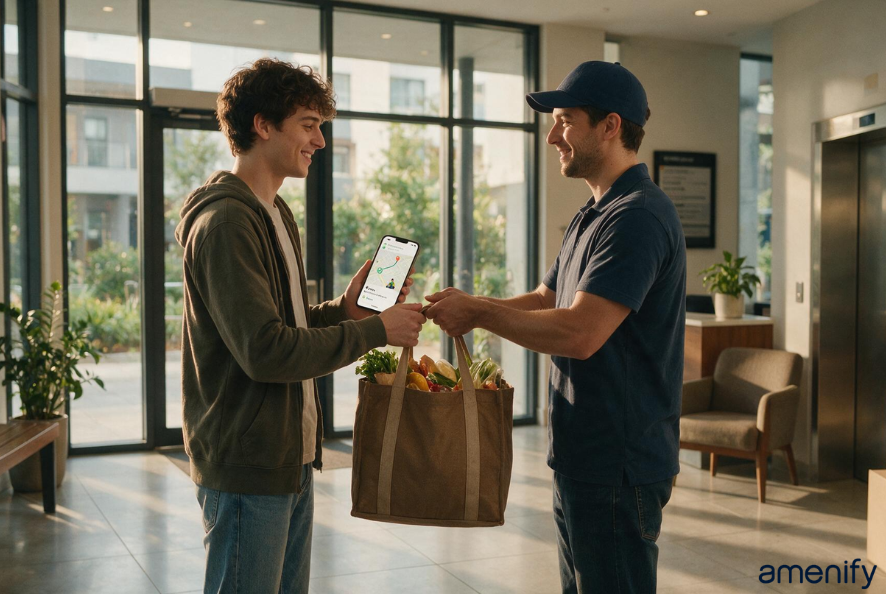
One resident app, fewer fragmented errands: grocery, local services, and more in one place.
Amenify isn't trying to out-inventory Instacart or undercut Walmart on toilet paper prices. It's solving a different problem entirely: it starts from the rental-housing workflow instead of forcing renters to bend a generic consumer app around their building's quirks.
Here's what that looks like in practice:
It's built around resident life, not just retail. Grocery sits alongside local services, dining, home services, and concierge support, all in one place, instead of five disconnected apps and five separate accounts.
It's already plugged into a lot of buildings. Amenify's integrations reach across roughly 15 million U.S. homes, which means it's frequently already wired into the access rules and workflows of the property you live in.
It reduces the number of things that can go wrong. Fewer fragmented apps means fewer one-off logins, fewer generic "leave at front door" instructions, and fewer groceries stranded in a lobby.
Property teams benefit too. For property managers, a consolidated resident-commerce layer means cleaner engagement data and one less disjointed vendor relationship to manage, which, in theory, means fewer small headaches turning into resident complaints.
The honest caveat: availability and exact service depth vary by market and by property integration, so it's worth checking what's live in your specific building. But the direction is clear: grocery delivery for renters is quietly merging into something bigger, resident commerce.
Frequently Asked Questions
-
Start with your building, not the app store. Check whether the service lets you save detailed access instructions (gate codes, callbox, floor), offers real substitution control, and, ideally, connects to your property's access or concierge systems. Store selection and pricing matter, but they're secondary to whether the app can actually get groceries through your front door.
-
It's an app that lets residents order groceries from local stores, marketplaces, or resident-service platforms, with delivery to an apartment, rental house, or shared building. The best ones for renters go a step further, handling building access, drop-off instructions, driver communication, and delivery proof, not just the checkout.
-
For apartment-specific logistics, building access, package rooms, bundled resident services, yes, that's exactly the gap Amenify was built to close. Generic marketplace apps can still be useful for broad store selection, but they weren't designed around the building the way Amenify is.
-
It depends on order size and frequency, but between delivery fees, service fees, tips, and item markups, costs can run anywhere from a modest premium to 30 to 40% over shelf price on routine items. A good rule of thumb: compare your last three orders' total cost (fees included) against in-store pricing before deciding if a subscription or pass is worth it.
-
Save detailed delivery instructions (entrance, gate code, floor, drop-off spot), pick a delivery window that avoids building rush hours, and use substitution rules so you're not stuck with the wrong item. If your property has a resident-commerce platform available, check what's already configured before defaulting to a generic app.
-
This is exactly where property-integrated platforms have an advantage; they can work with existing access rules, concierge desks, or package rooms instead of relying on a driver guessing. If theft is a recurring issue, opt for attended delivery or a staffed drop-off point instead of "leave at door."
-
They're most valuable for renters without a car, anyone in a building with parking or access friction, and households ordering heavy or bulky items regularly (pet food, drinks, paper goods). They're less worth it if you live within easy walking distance of a store and order infrequently, in that case, the convenience fee may not be worth it.
