

What Is Important to You When Choosing a Food Delivery Service?

Choosing the right food delivery service comes down to more than just what's on the menu.
Picture this: it's 7:45 on a Tuesday night, you haven't cooked, and your fridge has exactly one sad lemon and a jar of mustard in it. You pull out your phone, open a delivery app, and thirty seconds later you're staring at a $6.99 "service fee", a $3.49 "delivery fee", and a suggested tip that somehow makes a $14 burrito cost $26. Sound familiar?
You're not imagining it, and you're definitely not alone. Americans now spend serious money every year just to have food show up at their door, and with so many food delivery service options fighting for your thumb, it's easy to just default to whatever app you downloaded first and never think about it again. But a little bit of intention here can save you real money, real time, and a lot of cold, soggy fries.
So let's actually talk about it. What is important to you when choosing a food delivery service? Is it price? Speed? The sheer number of restaurants available? Whether the driver actually reads the "please ring doorbell" note?
In this guide, we're walking through every factor that matters, comparing the big names head-to-head, and answering the exact questions people are typing into Google right this second. By the end, you'll know exactly which app deserves a permanent spot on your home screen. So stay tuned.
Factors to Consider When Choosing a Food Delivery Service
Before you compare apps, it helps to know what you're actually comparing. These are the factors to consider when choosing food delivery that actually move the needle on your day-to-day experience:
Restaurant selection: Does the app cover the specific restaurants and cuisines you actually crave, or just the ones that happen to pay for placement?
Total cost, not just the delivery fee: Delivery fees, service fees, small-order fees, and taxes can quietly double your bill if you're not paying attention.
Delivery speed: How long does food realistically take to arrive in your zip code, especially during a Friday dinner rush?
Reliability: Do orders show up complete, warm, and correct, or is there a coin-flip chance something's missing?
Customer support: When something does go wrong (and eventually it will), how easy is it to get a refund or a real human response?
Subscription value: Is a monthly membership like DashPass, Uber One, Grubhub+, or an Amenify Bundle actually worth it for how often you order?
App experience: Clean navigation, accurate live tracking, and an easy checkout process matter more than people expect.
Keep these in mind, because the "best" app genuinely changes depending on which of these matters the most to you.
Before you compare apps further, it's worth checking whether Amenify is already part of your amenity package
Best Food Delivery Apps: How the Big Names Actually Compare
There's no single winner here, and any blog that tells you otherwise probably hasn't actually used all of them. Here's an honest food delivery service comparison of the platforms most Americans are choosing between right now.
DoorDash: Best for Selection
DoorDash dominates on sheer reach. It holds roughly two-thirds of the US food delivery market, and if a restaurant near you offers delivery at all, there's a very good chance it's listed here first. That makes DoorDash the easiest option if you live somewhere suburban or outside a major downtown core, where other apps sometimes have thinner coverage. Its DashPass subscription unlocks $0 delivery fees and lower service fees on eligible orders, which pays for itself quickly if you order more than once a week.
Uber Eats: Best for Speed and App Experience
If you already use Uber for rides, Uber Eats feels instantly familiar, and it tends to shine in dense cities like New York, Chicago, and San Francisco, where it can tap into Uber's existing driver network for genuinely fast delivery times. Multiple independent order comparisons have found Uber Eats to be the cheapest option more often than not, though DoorDash usually wins on pure restaurant variety. The interface is also widely considered the cleanest of the bunch, with intuitive checkout and reliable live tracking. The interface is how you can navigate to your preferred items fast.
Grubhub: Best for Value in Select Cities
Grubhub has quietly become the value pick, especially if you live in New York City, Chicago, Boston, or Philadelphia, where it remains genuinely competitive with the bigger players. Its Grubhub+ membership includes a cashback structure that DoorDash doesn't currently match, and Grubhub frequently comes out ahead in fee comparisons for smaller orders. If you tend to order for one or two people rather than a full family dinner, this is worth a serious look.
Amenify: Best for Apartment Residents
If you live in an apartment community, there's a good chance Amenify is already available to you and you just haven't noticed it yet. Unlike the consumer apps above, Amenify is built specifically as a resident amenity, offered through the property itself rather than downloaded cold off the app store. It works as an aggregator across roughly 900,000+ restaurants and 24,000+ grocery stores in 780+ cities, comparing options behind the scenes to route your order through the lowest available fees, with residents reporting savings of up to 30% compared to ordering directly through the big-name apps. New residents typically get a sign-up credit plus a recurring monthly credit just for using the service, and support runs through a dedicated concierge team rather than an app-only chat bot. If your building offers it, it's genuinely worth checking before you default to whichever app happens to already be on your phone. You can find out more about Amenify and its reviews for an even more informed decision.
Also Read: Amenify Food Delivery Service: Bringing Healthy Meals to Your Doorstep
Instacart: Best for Groceries and Restaurant Delivery Combined
Technically more of a grocery platform, Instacart has expanded enough into restaurant and prepared-food delivery that it deserves a mention if you like handling your weekly grocery run and the occasional takeout order from a single app. Delivery fees typically start around $3.99 for orders over $35, with an Instacart+ membership offering free delivery on qualifying orders.
ezCater: Best for Office and Group Orders
If you're the person responsible for feeding a whole office or a big family gathering, the consumer apps above weren't really built for that job. ezCater specialises in catering-sized orders, making it the better choice when you need food for fifteen people rather than food for one.
Amenify isn't always the cheapest option on paper, and that's not really the point. It's the best overall pick if you want one app that handles selection, fees, and reliability for you instead of making you compare five apps every time you're hungry.
Food Delivery Service Fees: What You're Actually Paying For
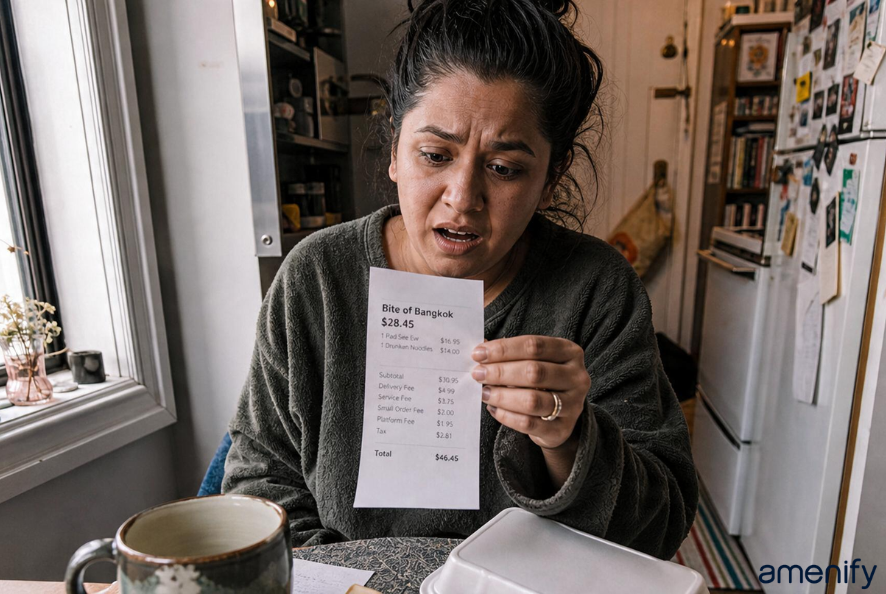
A food delivery service rarely advertises its full pricing structure upfront, and the fees stack in ways that can turn a reasonable meal into an expensive one.
This is where most people get caught off guard. A food delivery service rarely advertises its full pricing structure upfront, and the fees stack in ways that can turn a reasonable meal into an expensive one. Here's what typically shows up on your receipt:
Delivery fee: A flat or distance-based charge for getting the food to you, often somewhere between $2 and $8.
Service fee: Usually a percentage of your subtotal, commonly landing around 15%, though it varies by app and order size.
Small order fee: An extra $2 to $3 charge if your order falls under the app's minimum threshold.
Surge or peak pricing: Higher fees during high-demand windows, like Friday and Saturday dinner rushes.
Tip: Optional, but customary, and it goes directly to your driver.
A few practical ways to keep these costs down: order during non-peak hours (delivery fees are often noticeably lower between 2 and 5 PM), add a small side item to clear the minimum-order threshold instead of eating a surcharge, and always check the same restaurant across two apps before you check out, since prices for identical items can genuinely differ between platforms. If you order frequently, picking one subscription and sticking with it, rather than paying for DashPass, Uber One, and Grubhub+ all at once, is usually the single biggest money-saver available to you. If you're a renter, it's also worth checking whether your building already has an aggregator like Amenify built in, since that fee comparison happens automatically on your behalf, order by order.
Also Read: Enhancing Convenience and Quality: Professional Food Delivery Services
Affordable Food Delivery Services: How to Actually Save
If keeping costs down is your top priority, a few habits matter more than which single app you pick. Looking for affordable food delivery services starts with treating delivery apps the way you'd treat any other subscription or recurring expense. A few concrete strategies:
Compare the same order across two apps before confirming, since the "cheapest" platform genuinely shifts by city and restaurant.
Choose pickup instead of delivery when you can, which skips the delivery fee entirely and usually gets you your food faster.
Watch for first-order promo codes, which most platforms offer generously to new users.
Bundle a subscription with something you already pay for. Uber One, for instance, often overlaps with Uber ride credits if you're a regular rideshare user.
If your apartment community offers Amenify, use the sign-up and monthly wallet credits before turning to a separate paid subscription elsewhere.
Reliable Food Delivery Service: What Reliability Actually Looks Like
A reliable food delivery service isn't just about the app not crashing. It's about your order arriving complete, at the right temperature, with the right substitutions, and without a three-message back-and-forth with support afterward. Reliability tends to track closely with driver saturation in your specific area, which is part of why the "best" app really can vary block to block, not just city to city. If you've had repeated issues with missing items or long waits on one platform, it's genuinely worth trying a competitor in your same zip code before assuming all delivery is just unreliable.
Fastest Food Delivery Service: Who Actually Gets There Quickest
If speed is your priority, and let's be honest, hunger doesn't wait patiently, the fastest food delivery service for you will depend heavily on where you live. Uber Eats tends to have an edge in dense urban cores thanks to its large existing driver pool from rideshare, while DoorDash's broader driver network can sometimes win out in suburban or lower-density areas where fewer competitors operate. The only real way to know for certain is to time a couple of orders from the same restaurant on different apps and see which one actually gets to your door first.
Food Delivery Service Reviews: Do They Actually Help?
Reading food delivery service reviews before committing to an app can save you a lot of trial and error, but treat citywide or platform-wide reviews as a general guide rather than gospel. A five-star reputation nationally doesn't guarantee a great experience on your specific street, since so much depends on which drivers are actually active near you. Look for reviews specific to your city or neighborhood when possible, and pay closer attention to comments about order accuracy and support responsiveness than to star ratings alone.
Final Thoughts: Choosing What Actually Works for You
The right app doesn't just save you money; it makes this moment better too.
At the end of the day, there's no universally "best" food delivery service, no matter how confidently a headline claims otherwise. The right choice depends on what you're actually optimising for tonight: Are you trying to save a few bucks, get food in your hands as fast as humanly possible, or make sure your go-to Thai place is even on the app in the first place? The good news is that trying two or three platforms costs you nothing but a few minutes, and most of them will throw a first-order discount your way just for showing up.
So next time your fridge is looking as sad as that lone lemon, take the extra thirty seconds to think about what actually matters to you tonight. Your wallet and your dinner will thank you.
Also Read: The Ultimate Guide To Food Delivery: Satisfying your Cravings with Amenify
Why Choose Amenify?
If you happen to live in an apartment community, do yourself a favour and check whether Amenify is already part of your amenity package before you open anything else. Because Amenify works behind the scenes to compare pricing across hundreds of thousands of restaurants and grocery partners, residents often end up paying less for the exact same order than they would going straight through a standalone app, and the sign-up plus monthly wallet credits make it even easier to justify trying it out. Add in a dedicated concierge team for support and the fact that it's already built into where you live, and it's less an extra app to manage and more a quiet upgrade to a routine you're already doing every week.
Stop juggling five apps to find one good deal. Amenify does the comparing for you, and $50 in sign-up credits means your first few orders are basically on the house. so…
Frequently Asked Questions
-
There's no single answer, since it depends on your location, the restaurant, and current promotions. Independent order comparisons have found Uber Eats to be the lower-cost option more often than not, while Grubhub frequently wins on small orders in Northeast cities. If you live in an apartment community with Amenify available, its aggregator model is built specifically to route you toward the lowest fee automatically. Otherwise, comparing your specific order across two apps before checking out is the most reliable way to actually know.
-
If you order more than about once a week, yes. Subscriptions like DashPass, Uber One, and Grubhub+ typically cost around $9.99 to $12.99 a month and can eliminate delivery fees entirely on eligible orders, which usually pays for itself after two or three orders.
-
It depends heavily on where you live. DoorDash leads nationally by order volume, but Grubhub remains genuinely competitive in cities like New York, Chicago, Boston, and Philadelphia, so it's worth checking coverage for your specific zip code rather than assuming the national leader is automatically the local one.
-
Both work, but cash tips go directly to your driver without passing through the platform, while app tips are processed alongside your order. Either way, tipping is customary in the US and appreciated, since delivery driver pay often depends heavily on it.
-
Compare prices across apps, choose pickup when possible, use first-order promo codes, and consider subscriptions like Uber One if you order frequently. If your apartment offers Amenify, you can also use its sign-up and monthly wallet credits to reduce delivery costs.
