

Dog Temperature Chart: When Is It Too Hot or Too Cold to Walk Your Dog?

A comfortable temperature and a cool, shaded path make for a happy walk.
The short answer: most healthy dogs walk comfortably between 45°F and 75°F. Above 85°F the risk climbs fast, especially on pavement. Below 32°F small, short-coated, young and senior dogs need extra protection.
That is the heart of any good dog temperature chart. I'll give you the full chart below, plus the pavement test, breed adjustments and what to do when the weather says "not today".
If you've ever stood at the door with the leash in your hand, wondering, "Is it too hot out there?" this guide is for you. We wrote it for real daily life, including busy workdays when someone else needs to handle the walk.
What Is a Dog Temperature Chart?
A dog temperature chart is a simple guide that shows which outdoor temperatures are safe, risky or dangerous for walking your dog. Most charts use color zones: green for safe, yellow for caution and red for danger.
Think of it as a traffic light for your dog's walk. It won't replace your vet's advice, but it gives you a fast answer before you leave the house. Keep in mind that every chart is a guideline. Your dog's breed, coat, age, weight and health all shift the numbers.
Can't get home in time for a midday walk when the chart says "caution"? Let a trusted local walker handle it while you stay at work.
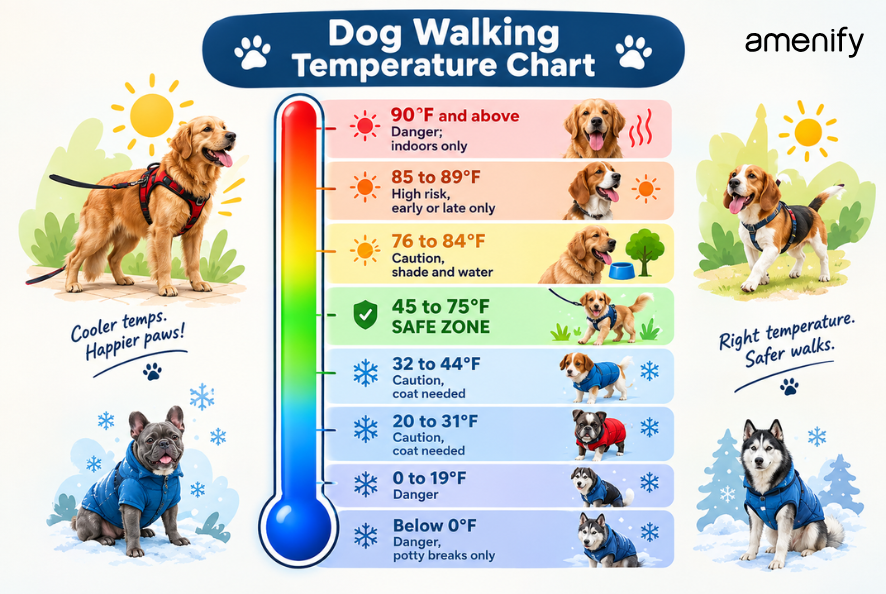
Quick look at the dog walking temperature chart
What Is the Safe Temperature to Walk a Dog?
For most healthy adult dogs, the safe range is about 45°F to 75°F. Several dog walking charts, including one from Dogchart, put the full safe zone in that range with no restrictions. Another guide gives the same 45°F to 70°F baseline and says safety depends on breed, weight and coat once you move outside it.
Here is the master chart we use as a starting point. It assumes a healthy adult dog, dry weather and a normal coat.
| Air Temperature | Zone | What to Do |
|---|---|---|
| Below 0°F | Danger | Potty breaks only. Come straight back inside. |
| 0°F to 19°F | Danger | Very short outings. Coat and boots for most dogs. |
| 20°F to 31°F | Caution | Short walks. Small, short-haired, young and senior dogs need a coat. |
| 32°F to 44°F | Caution | Normal walks for most dogs. Watch small and thin-coated dogs. |
| 45°F to 75°F | Safe | Ideal for long walks and play. |
| 76°F to 84°F | Caution | Shorten walks. Stick to shade and grass. Bring water. |
| 85°F to 89°F | High risk | Early morning or late evening only. Do the pavement test. |
| 90°F and above | Danger | Potty break only. Offer indoor play instead. |
This chart is a general guide, not veterinary advice. Talk to your vet about your own dog.
You can also read: 10 Types of Pet Services Every Pet Owner Should Know About
How Hot Is Too Hot to Walk a Dog?
For most dogs, 85°F is the line where a walk becomes risky. Once the air hits about 85°F, dogs start to be at risk, especially flat-faced breeds, dogs with dark or thick coats, puppies, seniors and dogs with medical conditions. Some breeds feel heat at even lower numbers.
Humidity matters too. Dogs cool themselves mostly by panting, and panting works poorly in damp air. Here is the easy rule many pet pros use: add the air temperature in Fahrenheit to the humidity percentage. If the total reaches 150 or higher, skip the walk and keep your dog inside. A day that is 80°F with 80% humidity adds up to 160, so that walk is off.
Why does this matter so much? Because heat can turn dangerous quickly. Heatstroke may set in when a dog's body temperature rises above 105.8°F, and it can develop within minutes in hot, humid conditions. That is not a "wait and see" situation.
Quick heat checklist before you go:
Check the air temperature and the humidity.
Add them together. If the total is 150 or more, stay in.
Pick the coolest part of the day, usually early morning or after sunset.
Choose shade and grass over asphalt.
Pack water for both of you.
Is the Pavement Too Hot for My Dog?
Pavement is often the real danger, even when the air feels fine. Asphalt soaks up sun and holds heat. At 75°F air temperature, sunlit asphalt can reach about 125°F, and paw burn risk starts once the ground passes roughly 120°F. It also stays hot for a while. Pavement can stay hot for 1 to 2 hours after sunset.
Here is how the surface temperatures stack up in direct sun:
| Air Temp | Asphalt | Concrete | Grass |
|---|---|---|---|
| 75°F | about 125°F | about 103°F | about 77°F |
| 80°F | about 130°F | about 108°F | about 82°F |
| 85°F | about 135°F | about 113°F | about 87°F |
| 90°F | about 140°F | about 118°F | about 92°F |
| 95°F | about 145°F | about 123°F | about 97°F |
The 10-second hand test:
Press the back of your hand flat on the pavement.
Hold it there for 10 seconds (some vets say 5 to 7).
If you can't keep it there comfortably, don't walk your dog on it.
The Cornell University College of Veterinary Medicine offers the same test, using your hand or bare foot for about 10 seconds. The AKC's chief veterinary officer adds that hot pavement can also raise a dog's body temperature and contribute to heatstroke, not just burn paws.
How Cold Is Too Cold to Walk a Dog?
Most dogs do fine in the 30s and 40s. The trouble starts below freezing, and wind chill makes it worse.
Once it dips to 45°F or lower, spend less time outside with small, weak or older dogs, and at 20°F or below cold-related health problems become a real risk. A widely shared winter chart based on Tufts University guidelines makes the same point: use the "feels like" wind chill number instead of the air temperature, and remember that wet weather adds risk.
Cold weather rules we follow:
Dress small, short-haired, young and senior dogs in a coat once it's near freezing.
Shorten walks as the wind picks up.
Rinse paws after every walk to remove salt and de-icer. Water-resistant boots are the best defense, and a rinse helps if your dog goes barefoot.
Dry between the toes to prevent ice balls.
Keep your dog from eating snow. Eating a lot of snow can lower body temperature.
Freezing mornings and early sunsets make winter walks hard to fit in. A dog walking service can handle quick, bundled-up outings so your dog stays active when you can't be.
Does Breed, Size or Age Change the Dog Temperature Chart?
Yes. The chart above is your baseline. These adjustments matter a lot.
| Dog Type | Examples | Safe Range (rough guide) | Watch Out For |
|---|---|---|---|
| Flat-faced breeds | French Bulldog, Pug, Boston Terrier | 35°F to 75°F | Overheating at lower temps |
| Small breeds | Chihuahua, Dachshund | 45°F to 85°F | Getting cold fast |
| Thick-coat breeds | Golden Retriever, Husky, German Shepherd | 15°F to 80°F | Heat above 80°F |
| Medium and mixed breeds | Beagle, most mixes | 30°F to 85°F | Caution zones on both ends |
Ranges are adapted from published breed-type guides, including a Fourcast dog temperature chart. Treat them as starting points.
Age and health matter too. Flat-faced dogs, seniors and puppies carry a higher heatstroke risk in hot weather. Overweight dogs and dogs with heart or breathing problems need extra care. When in doubt, ask your vet what range fits your dog.
What Are the Signs Your Dog Is Too Hot or Too Cold?
Your dog will tell you if you know what to look for.
Signs of overheating
Early: heavy panting, drooling, seeking shade, slowing down. Heavy panting, whining and reluctance to play can be early signs.
Serious: red gums, vomiting, weakness, stumbling, confusion.
Emergency: collapse, seizures, struggling to breathe. Drooling and panting that won't stop, trouble breathing, weakness, seizures or collapse mean a vet visit right away.
Signs of being too cold
Shivering or shaking
Lifting paws off the ground
Whining or stopping mid-walk
Trying to turn around and head home
A hunched posture with a tucked tail
If you see any of these, end the walk. Don't push for "just a few more minutes."
What Should I Do If My Dog Overheats?
Act fast and stay calm.
Get out of the heat. Move to shade or air conditioning right away.
Offer small sips of cool water. Don't force it.
Cool your dog gradually. Use cool (not ice-cold) water on the belly, paws and armpits.
Call your vet or the nearest emergency clinic. Heatstroke is an emergency even if your dog seems to recover. Heatstroke is a life-threatening medical emergency.
The best fix for heat trouble is never being out there in the heat. On hot weeks, book short, shaded potty breaks with a walker who knows when to stay inside.
How Do Dog Walkers Use a Dog Temperature Chart?
This is the part most guides skip. A good dog walker doesn't just follow the leash. They check conditions every day and adjust. Here is How to Choose a Dog Walker Your Dog Will Actually Love.
Here is what a careful walker does:
Checks air temperature, humidity and wind chill before leaving.
Tests the pavement with the hand test on every route.
Changes the route to shaded paths and grass.
Shortens the walk or swaps it for a potty break and indoor play.
Carries water and watches your dog's body language.
Updates you if the weather changed the plan.
You can help too. Tell your walker about your dog's breed, coat, age, health and any heat or cold sensitivities. Ask them about their weather policy before the first booking. Agree in advance on what happens at 90°F, in a snowstorm or on a smoggy day.
Apartment tip: Many city and apartment dogs live where concrete courtyards, sunny sidewalks and hot balconies trap heat. Ground in the shade can be 20 to 30 degrees cooler than the sun-baked parking lot. A walker who knows your building can pick the right door and the right route.
On days outside the safe zone, try these swaps:
A 10-minute potty break plus a snuffle mat or puzzle feeder
Indoor hide-and-seek with treats
A short training session in the hallway
A kiddie pool in the shade on hot days (for dogs who like water)
If your dog makes a lot of mess after walks, you can also consider professional apartment cleaning service.
How Can Amenify Help When the Weather Gets Rough?
Amenify is a platform that connects residents of partner apartment communities with on-demand services, including dog walking, booked through an app. When the dog temperature chart says "not safe for a long walk", you can still make sure your dog gets a break, fresh air and attention.
With a dog-walking services option built into your building's resident experience, you don't have to rush home from work or skip a meeting to avoid a 3 p.m. heat spike. You choose the time, share your dog's needs and let someone local handle it.
Ready to take weather stress off your plate? Book a walk through Amenify and tell us how your dog handles heat and cold.
The Bottom Line on Walking Your Dog by the Numbers
Here's what I want you to remember. The dog temperature chart gives you a quick yes, maybe or no. Green is 45°F to 75°F. Yellow is the cooler and warmer edge. Red is 85°F and above, or well below freezing. Add the pavement test, watch your dog's body language and adjust for breed, age and health.
And on the days that don't fit your schedule or the weather, you don't have to choose between your dog's safety and your workday. A trusted dog walking service can carry the leash while you stay safe, cool and on time.
Your dog doesn't care about the number on the thermostat. They just want you. The chart helps you give them the right kind of walk, every season.
Frequently Asked Questions
-
For most dogs, 85°F and above is too hot for a normal walk, and 90°F or higher means potty breaks only. Flat-faced, thick-coated, senior and puppy dogs can struggle at lower temperatures. Always check humidity and pavement too.
-
The sweet spot is 45°F to 75°F for most healthy adult dogs. Within that range you can usually do a full walk, play fetch or go on a longer outing.
-
It can be. At 80°F, dogs with low heat tolerance, such as flat-faced breeds, should skip long walks. Healthy dogs may manage a short walk in shade, but check humidity and test the pavement first.
-
Avoid it. At 90°F, asphalt in the sun can reach roughly 140°F, which can burn paw pads. Stick to a quick potty break on grass and play indoors.
-
Below 32°F, small, short-haired, young and senior dogs need a coat and shorter walks. At 20°F or lower, most dogs should only go out for brief potty trips. Use the wind chill temperature, not just the air reading.
-
For many dogs, no, but it's a caution zone. A large, thick-coated dog may enjoy a normal walk, while a small or thin-coated dog needs a sweater and a shorter outing.
-
Press the back of your hand on it for 5 to 10 seconds. If it's uncomfortable for you, it's too hot for your dog's paws. Walk on grass or in shade instead.
-
Yes, if you can't be home. A good walker adjusts the route and length to the weather, so your dog still gets a break without taking on extra risk.
