

Resident Commerce Is Becoming a Strategic Operating Layer in Multifamily
From Resident Experience to Resident Infrastructure
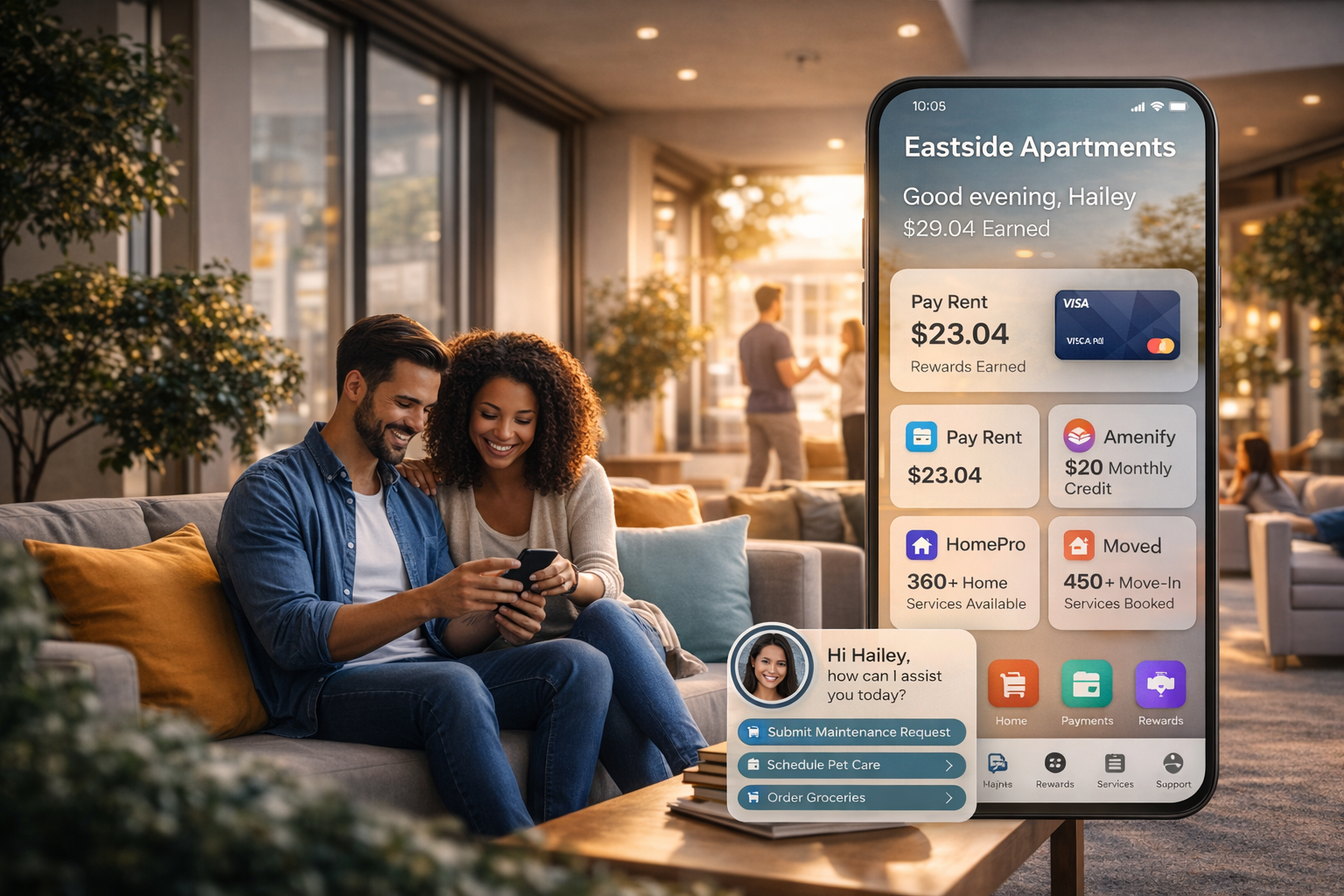
The next evolution in multifamily will not be defined by more amenities. It will be defined by more connected living.
For years, multifamily treated resident experience as an enhancement to operations rather than an extension of it. Concierge services, rewards, local offers, and moving support were often positioned as value-adds around the edges of the resident journey. That framing is beginning to break down. Across the industry, the more meaningful shift is toward embedding those experiences directly into the systems residents and property teams already use.
This is what makes resident commerce more than a convenience story. It is becoming part of the operating model.
Why Embedded Ecosystems Are Gaining Ground
The forces behind that shift are easy to understand. Operators are being asked to improve the resident experience while protecting team capacity and driving measurable efficiency. At the same time, residents increasingly expect the kind of seamless, app-based convenience they receive in every other part of consumer life. In that environment, disconnected point solutions lose appeal quickly. The platforms gaining traction are the ones reducing friction across the full resident lifecycle, not just solving for one task at a time.
Entrata’s Homebody RXP, for example, was launched as a unified environment for lease signing, move-in and move-out workflows, payments, maintenance, amenity booking, communication, and community engagement. RealPage’s LOFT was built around a similar premise, bringing leasing, moving, payments, and rewards into a single resident experience layer.
Resident Expectations Are Evolving Faster Than Legacy Workflows
The 2024 NMHC and Grace Hill Renter Preferences Survey includes input from more than 172,000 renters living in 4,220 communities across 77 markets nationwide, covering everything from apartment search and lease decision factors to technology needs, connectivity, pricing expectations, and future rental behaviour. At that scale, the takeaway is hard to ignore: residents are evaluating housing through a much broader lens than the unit itself. They increasingly expect the living experience to feel more connected, more intuitive, and more responsive to the way they manage the rest of daily life.
That is what makes embedded resident commerce strategically important. When operators can connect support, services, payments, rewards, and engagement inside a single resident environment, they are not simply layering on convenience. They are aligning with a measurable shift in renter expectations and building a model that is better suited to how residents increasingly want to interact with where they live. In that sense, resident commerce is becoming part of how communities compete for both retention and long-term relevance.
Platform Convergence Is Accelerating
What is happening across the market also suggests that this is not an isolated trend. RealPage said LOFT grew from more than 200,000 units in beta across 30+ property managers to more than 600,000 units after launch, a 300% increase in adoption. The company positioned that growth around a unified resident experience that reduces reliance on point solutions, improves site efficiency, and supports retention and renewals. That kind of expansion signals that the market is rewarding connected platforms, not fragmented resident tools.
The same pattern is visible in adjacent partnerships. In March 2026, Entrata said its Homebody integration with Cobu was designed to bring measurable engagement, leasing, and retention outcomes directly inside the resident app, with Cobu communities reporting renewal gains of up to 25% and monthly resident engagement above 70%. Those are strong indicators that resident-facing platforms are becoming more than communication channels. They are increasingly being used as operating systems for engagement, conversion, and long-term resident value.
Amenify’s Growth Reflects a Broader Market Shift
Amenify’s 2025 story fits squarely into that broader market evolution. The most important part of its momentum is not simply that it expanded services. It is that the company appears to be building resident commerce as an embedded layer across the everyday living experience: support, local services, shopping, gifting, payments, and rewards, all designed to work inside existing multifamily platforms rather than alongside them.
That distinction matters because embedded models typically scale faster than standalone tools in property operations. Amenify said it saw 16x year-over-year growth in active users following its API launch, along with roughly 70% year-over-year growth, a milestone of more than 100,000 five-star reviews, and a 92% satisfaction score for its support operation.
That growth profile says something important about where the category is headed. Multifamily does not need more resident-facing apps that require separate adoption curves. It needs infrastructure that becomes native to the resident journey. When service access, support, rewards, and commerce are presented inside the same environment residents already use for rent, maintenance, and community interactions, engagement becomes easier to sustain and operational lift becomes easier to justify.
Entrata’s June 2025 partnership with Amenify is a good example of that logic in action. Homebody RXP users were given access to Amenify-managed services inside the platform, including a $50 move-in credit and a $20 monthly credit for services such as home cleaning, handyman work, dog walking, and delivery.
The Strategic Value of Embedded Commerce
What matters strategically is not the credit amount. It is the design principle. Resident value is increasingly being delivered through embedded ecosystems rather than isolated offerings.
That has three major implications for the multifamily industry.
First, the resident journey is becoming more continuous. Leasing, moving, payments, support, maintenance, renewals, and local services are no longer being treated as separate experiences. The market is moving toward platforms that connect those touchpoints into a single environment, where each interaction creates context for the next. That continuity is useful for residents, but it is just as valuable for operators because it reduces fragmentation across property workflows.
Second, convenience is becoming more economically relevant. Historically, resident experience investments were often justified through softer outcomes such as satisfaction or brand perception. Embedded commerce changes that equation. When support, services, and rewards are woven into the operating stack, they can contribute to engagement, ancillary spend, faster response times, and lower workload for onsite teams. Amenify’s national in-house concierge model and sub-minute response positioning, combined with its API-based approach, suggest that resident commerce is being built not just as a perk layer, but as a productivity layer.
Third, ecosystem partnerships are becoming more important than standalone feature development. The next phase of multifamily technology will likely be defined less by who ships the flashiest resident feature and more by who assembles the most useful network around the resident. That is why partnerships matter so much in this category. Amenify’s ecosystem now includes integrations or collaborations spanning Visa, Entrata, and service-network relationships designed to widen coverage and reduce friction. Entrata, meanwhile, has continued to expand Homebody through adjacent partnerships such as Cobu, reinforcing the broader market direction: unified resident platforms become more valuable as more capabilities are embedded into them.
Payments Are Becoming Part of the Resident Platform
The Visa collaboration is especially revealing. Amenify announced in January 2026 that residents will be able to link an existing Visa card and earn value on eligible rent payments and everyday spending with select merchants, without changing the payment experience or requiring a new card. That is strategically significant because it turns the payment layer into part of the resident experience itself.
For decades, rent has been a high-frequency, high-importance transaction with very little experiential upside. Connecting that transaction to rewards, local commerce, and resident services shifts housing from a series of isolated operational moments into a more connected economic platform.
From Feature Expansion to Infrastructure
That is the larger takeaway from Amenify’s 2025 evolution.
The real story is not that resident commerce is adding more features. It is that resident commerce is maturing into infrastructure. As operators look for ways to improve retention, simplify operations, and deliver a more modern experience without expanding complexity, embedded commerce becomes far more compelling. It aligns with where multifamily platforms are already heading: toward fewer silos, more continuity, and a tighter connection between resident satisfaction and operating performance.
In that context, the companies worth watching are not just those offering resident perks. They are the ones quietly redefining how the apartment experience is delivered behind the scenes. Amenify’s 2025 suggests that resident commerce is moving into that category.
