

Why Third-Party Property Managers Are Rewriting the Playbook on Ancillary Income
Ancillary income is no longer a side conversation
For third-party property managers, margin pressure has a way of exposing what actually moves the needle.
When rent growth slows and operating costs stay elevated, management teams can’t rely on the usual levers alone. They’re still expected to protect property performance, improve resident experience, and show ownership groups that the asset is being managed with precision. The challenge, of course, is that third-party managers often don’t control every major decision. They may influence strategy, but they don’t always own pricing, capital plans, or long-term investment priorities.
That’s what makes ancillary income more important right now.
What used to be viewed as a supplemental revenue stream is becoming something more strategic. For third-party managers, ancillary income is increasingly part of the proof point. It shows whether a management company can uncover new revenue, support NOI, and deliver added resident value without creating operational drag.
This is the shift underneath the conversation: ancillary income is no longer just about adding fees. It’s about demonstrating a more modern, more resilient operating model.
Why ancillary income matters more in 2026
For a long time, ancillary revenue sat in the background of multifamily operations. Useful, yes. Critical, not always.
That’s changing.
As market conditions tighten, third-party managers are under more pressure to show measurable impact beyond occupancy and collections. Owners still expect strong execution, but they also want to know whether their management partner can find additional ways to strengthen property performance without leaning entirely on rent growth.
That is where ancillary income starts to stand out.
It gives management teams another path to influence the financial story of the asset. Instead of depending solely on higher rents to improve performance, managers can build revenue through services, convenience offerings, and resident-focused programs that add value in a more flexible way.
There’s also a practical reason this strategy is getting more attention: the best ancillary income programs are easier to defend when they are tied to something residents can actually use. In other words, the conversation works better when it’s framed around service and convenience rather than charges alone.
That distinction matters. Residents are far more likely to respond well to a program that feels useful than one that feels purely transactional. And for third-party managers, that difference can shape everything from leasing conversations to renewal outcomes to owner confidence.
The new definition of ancillary income
It’s broader than parking, pet fees, and storage
Ancillary income used to bring a familiar set of examples to mind: parking, storage, pet-related revenue, utility billing, and other property-level add-ons.
Those categories still matter, but the definition has expanded.
Today, ancillary income increasingly includes bundled resident services and benefit packages designed to create both operational and financial value. These may include convenience-driven offerings, maintenance support services, renters insurance programs, credit-building tools, or other resident-facing products that sit alongside the core lease experience.
That broader mix changes the conversation.
The old model was mostly transactional. Add a fee, collect revenue, move on.
The newer model is more integrated. It treats ancillary income as part of the resident experience and part of the property’s operating strategy at the same time. When structured well, these offerings do more than generate income. They help shape how residents experience the community and how ownership evaluates management performance.
For third-party managers, that is a meaningful evolution. It moves ancillary income out of the accounting bucket and into the larger operating story.
Why this matters?
Specifically for Third-Party Property Managers
Owner expectations are changing
Third-party managers are not judged only on whether the building runs. They are judged on whether they create value.
That is an important difference.
An owner-operator may approach ancillary income as one piece of a broader portfolio strategy. A third-party manager has to approach it differently. For them, ancillary income can become a visible sign of operating sophistication. It shows whether the management company can identify new opportunities, implement programs effectively, and connect day-to-day operations to asset-level performance.
That matters in a competitive management environment.
Owners want strong reporting, disciplined execution, and reliable onsite operations. But increasingly, they also want management partners who can identify revenue opportunities that make sense for the asset and the resident experience. They want evidence that their manager is not simply maintaining performance, but actively improving the business.
Ancillary income helps managers tell a stronger owner story
This is one of the biggest reasons the topic has become more relevant.
A strong ancillary income strategy gives third-party managers something tangible to bring into ownership conversations. It creates a clearer narrative around value creation. Instead of focusing only on traditional metrics like occupancy, delinquency, and turn times, managers can also point to programs that support NOI, create resident utility, and reflect a more thoughtful operating approach.
That story matters because it differentiates.
Many firms can claim strong onsite execution. Fewer can show a repeatable way to introduce resident-facing revenue streams without creating friction for staff or frustration for residents. The real advantage is not simply having ancillary income. It is being able to operationalize it well.
Where ancillary income strategies break down
More fees is not the same thing as more value
This is where a lot of multifamily strategies lose momentum.
Ancillary income works when the resident can understand the value behind it. It works when the program is transparent, relevant, and easy to explain. It works when onsite teams are not left carrying the burden of a poorly structured rollout.
It tends to fail when the opposite is true.
If a program feels layered on, hard to explain, or disconnected from the resident experience, it can create pushback quickly. What looks attractive in a financial model can become a headache at the property level. Leasing teams have to answer for it. Residents question it. Owners scrutinize it. And the management company ends up managing the friction instead of the benefit.
For third-party managers, that risk is especially important because they sit at the center of multiple expectations. They need resident buy-in, owner confidence, and operational consistency. A weak ancillary income strategy can strain all three.
Execution is the real differentiator
The strongest ancillary income programs do not succeed because they add more line items. They succeed because they are built into the operating model.
They are clear. They are easy to communicate. They connect to a service residents recognize. And they do not create unnecessary complexity for already stretched teams.
That may be the most overlooked part of the discussion.
In multifamily, it is easy to talk about revenue in theory. It is much harder to implement a resident-facing program in a way that feels coherent at the community level. That gap between idea and execution is where a lot of value is either created or lost.
Where Amenify becomes relevant
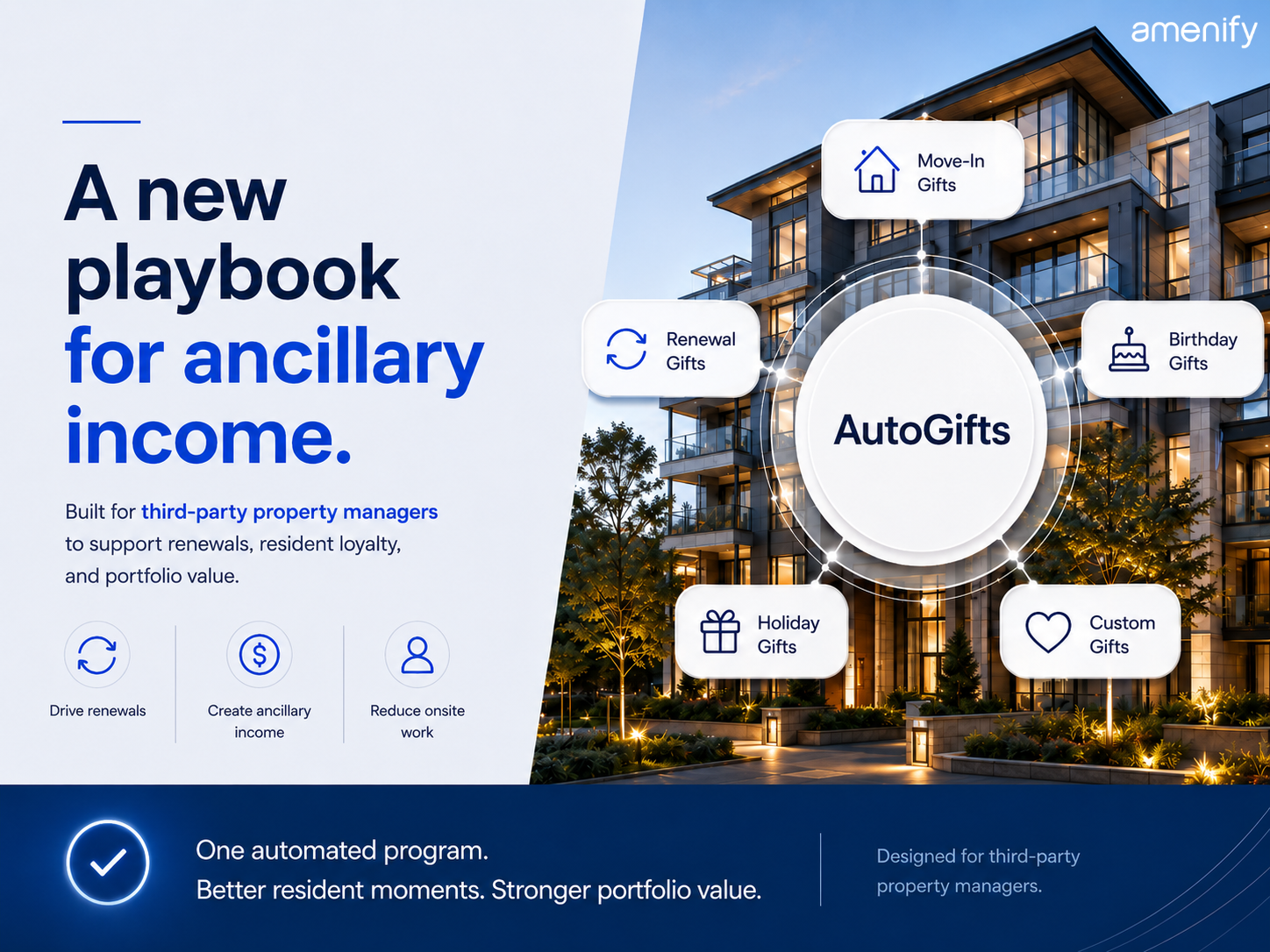
This is where Amenify fits naturally into the conversation.
Third-party managers do not need more revenue ideas in theory. They need models that can actually work across real communities without creating more operational friction for onsite teams. That is where service-driven ancillary income becomes more compelling than disconnected fee strategies.
Amenify helps bridge that gap by turning resident-facing services into a more organized, scalable part of the operating model. Instead of treating ancillary income as a standalone charge, managers can create offerings that feel useful to residents, manageable for teams, and measurable for ownership groups.
That matters because the upside is not just incremental revenue. It is a cleaner way to align resident experience, property operations, and owner performance goals. For third-party managers, that makes ancillary income more than a line item. It makes it part of a stronger operating story.
The bigger shift in third-party management
Good management now means more than operational stability
The real story here is larger than ancillary income itself.
Third-party property managers are being asked to expand what good management looks like. It is no longer enough to keep occupancy healthy, control expenses, and respond to service requests. Those expectations remain foundational, but they are no longer the full picture.
Ownership groups increasingly want managers who can identify new operating levers, support stronger resident retention, and contribute more directly to the performance of the asset. They want management teams that can connect operations, resident experience, and financial outcomes in a way that feels intentional.
That is why ancillary income has moved closer to the center of the conversation.
Done poorly, it is just another fee category.
Done well, it becomes something much more useful: proof that a management company understands how to build revenue through services, create value that residents can feel, and support property performance in a market where the traditional playbook is under more pressure.
And that is exactly why third-party property managers are rewriting the playbook.
